The walk encompasses three small villages along the Tywi Valley, all with a wealth of archaeology and history: Nantgaredig, Pontar-gothi and Llanegwad.
Nantgaredig is a modern village that developed after the arrival of the railway in 1865. The line closed in 1963, but some station buildings can still be seen. The walks cross the railway track bed at several points, so look out for cuttings, embankments and bridges.
There are, however, more ancient remains around the village. Amongst the most significant sites are the earthwork remains of a henge monument, built over 5,000 years ago, evidence of some of the first inhabitants of the region.
Henges are thought to have been important ceremonial sites during the Neolithic period, the age of the first farmers. Nearby, Llandeilo-yr-ynys was reputedly the birthplace of St Teilo in the 6th century, one of the great figures of the early Christian church in Wales.
Pont-ar-gothi is an ancient bridging point over the River Cothi, and the Roman road that runs along the valley must have crossed the river near here. There was a corn mill and a chapel close to the present bridge in medieval times, but the Cothi Mill is long disused and St Mary’s Chapel no longer remains. The village is notable for its three inns.
Llanegwad takes its name from Egwad, a saint of the Dark Ages, who is said to have founded the first church here. In medieval times Llanegwad was a small borough town controlled by the Bishop of St David’s. The Black Book of St. David’s, a rent roll of 1326, shows that the inhabitants’ duties to the Lordship included maintenance of the Lord’s Mill (probably the Cothi Mill near the bridge in Pont-ar-gothi) and escorting prisoners to the Lord’s court at Meidrim.
The broad sweep of the Tywi river valley, skirted by extensive flood plains and agricultural land, is the dominant feature of the area. The river supports a variety of rare plant and animal life and is designated as a Site of Special Scientific Interest and as a Special Area of Conservation. Away from the river the area is no less interesting, the hedge-banks in summer
Why Walk?
The circular walk to the west of the attractive little village of Llanegwad offers a gentle stroll on fairly even ground.
How Long?
It is approximately 3.5km (2.25miles) long and provides picturesque views along the Tywi valley.
How Hard?
The paths running east and west from Nantgaredig are quite level but do have some stiles on them. The paths to the north of the A40 are a little more taxing with some steeper ground and may be muddy in places even during the summer. Stout footwear is therefore recommended. Please note some of the paths lead to sections of "A" class road with fast moving traffic and without pavements. Children will need close supervision
Starting point
Parking - ✔
Public Transport - ✔
Refreshments - ✔
Points of Interest
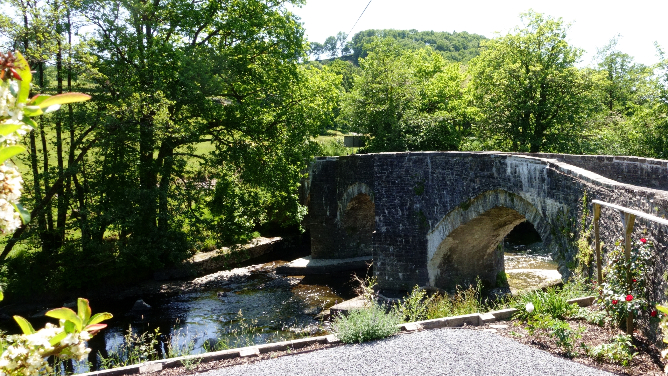
1. The fine, three-arched stone bridge over the Tywi at Llandeilo-yr-ynys, south of Nantgaredig, was built in 1786, a time when many new turnpike roads were being built to modernise the communications network of the country.
2. Trains running on the Central Wales and Carmarthen Junction Railway Line (opened in 1865) once stopped at Nantgaredig station now the new Tywi Valley Path which follows the old line from Carmarthen to Llandeilo (13miles). The Railway Hotel stands beside the old railway station and is still open for business despite the closure of the railway in 1963. Communication routes of all periods have run along the Tywi floodplain. The Roman road between the forts of Llandeilo and Carmarthen runs parallel to the modern A40.
3. Flocks of Canada Geese and Goosanders (beautiful saw-billed ducks) can occasionally be seen on the river. These scarce fish-eating birds were first recorded as a breeding bird in Carmarthenshire in 1980. During the summer months the riverbanks provide nesting sites for Sand Martins, while Sedge Warblers can often be seen or heard in the shrubs and trees lining the river.
4. Just outside the South Gate entrance to the Alltyferin estate stands Glan-Cothi, originally a farmstead but transformed into a grander building by the early 19th century when it was the home of the Hughes family. The famous Methodist leader Howell Harris preached here on several occasions in the mid-18th century.
5. Pen y Cnap motte castle, which stands to the west of Llanegwad, is a relic of the conflicts of the 12th and 13th centuries between the powerful princes of Dinefwr, and the Anglo Norman invaders. The Tywi valley was fought over until the fall of princes in the late 13th century. Llanegwad Castle was recorded as being gained by Rhys Ieuanc, son of the Lord Rhys, in 1203.